
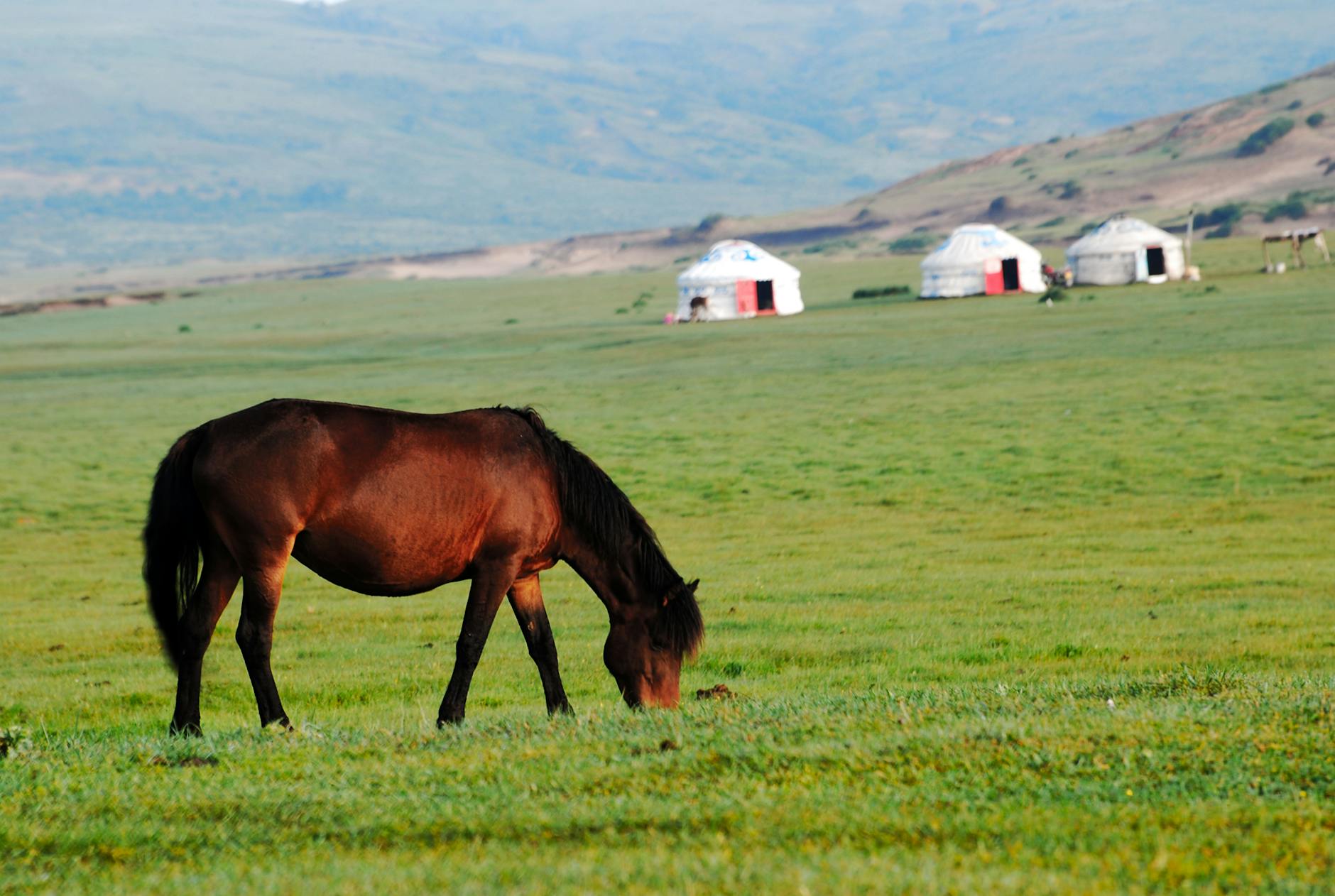
The Last True Wilderness — A Journey Beyond the Edge of the Known World
There are destinations, and then there are revelations. Mongolia is the latter — a country so immense, so unmediated, and so profoundly indifferent to the modern world’s noise that merely arriving feels like an act of courage. Few places left on Earth ask this much of a traveler — and give back so much more in return.
The Last Frontier of the Ancient World
Stand on the open steppe of central Mongolia on a clear May morning, and you will understand something that photographs cannot convey: this is what the Earth looked like before we started rearranging it.
The Mongolian steppe stretches in every direction to the curvature of the horizon — not the false horizon of a hill or a tree line, but the actual, geometric edge of the planet. The sky here is not a backdrop; it is a presence. It occupies more of your visual field than the ground beneath your feet, and on a day when the clouds roll in low from the northwest, it presses down on the grasslands like the hand of something ancient and enormous.
Mongolia is, by virtually every measure, one of the least-populated countries on Earth. With approximately 3.5 million people dispersed across a territory four times the size of California — and nearly half of them concentrated in the capital, Ulaanbaatar — the countryside unfolds as a landscape of almost geological silence. There are no fences. There are no billboards. In many regions, there are no roads to speak of — only tire tracks pressed into the earth by the same herders who have navigated these plains by memory and instinct for centuries.
This is not emptiness. This is space — and space, as any traveler who has experienced its scarcity in the crowded corners of the world will tell you, is perhaps the most precious thing left on Earth.
A Culture That Has Survived on Its Own Terms
Modern travel has a troubling tendency to turn cultures into performance — to reduce the living, breathing complexity of a people into folklore, costumes, and curated experiences designed for the camera. Mongolia resists this reduction with a stubbornness that borders on the majestic.
The Mongolian nomadic tradition is not a relic. It is not reconstructed for tourists or preserved behind museum glass. Across the country’s vast interior, hundreds of thousands of herder families continue to live as their ancestors did — moving with the seasons, following the grass, building and dismantling their gers (the circular felt-and-wood dwellings the outside world calls yurts) with practiced efficiency. A family can have their home fully erected in under two hours. They carry everything they own. They need no landlord, no utility company, no mortgage. Their relationship with the land is intimate and reciprocal in ways that post-industrial societies have largely forgotten.
To be invited into a herder family’s ger is to experience hospitality in its most elemental form. You will be offered airag — fermented mare’s milk, slightly alcoholic and slightly sour, with a taste unlike anything in the Western culinary vocabulary. You will be expected to drink it, and you will be glad that you did. You will be given suutei tsai, the salted milk tea that functions here as water does elsewhere — offered constantly, reflexively, as the first gesture of welcome. The family’s children will watch you with a combination of shyness and frank curiosity. Someone will produce a bowl of aaruul, the dried curd that herders carry as trail food, hard as chalk and intensely savory. The conversation will find its way through the language barrier through gestures, smiles, and the universal grammar of shared meals.
These are not tourist interactions. They are human ones. Mongolia has not yet learned to commodify its generosity, and that, perhaps more than any landscape, is what its visitors cherish most.
The Gobi: A Desert That Defies Expectation
Most people, when they hear the word “desert,” conjure images of Lawrence of Arabia — dune seas and scorching sands, bleached bones and mirage horizons. The Gobi is something altogether different, and altogether stranger.
Covering roughly a third of Mongolia’s southern territory and spilling into northern China, the Gobi is classified as a cold desert — and cold is emphatically the operative word. Winter temperatures plunge to -40°C. The landscape shifts between sand dunes, gravel plains, rocky outcroppings, and saxaul forest with a geographic abruptness that suggests the work of a distracted cartographer. In a single afternoon’s drive, you might cross three or four entirely distinct ecosystems.
The Khongoryn Els sand dunes — known among the herders who live near them as the “Singing Sands” for the low, resonant hum they produce in the wind — rise to 300 meters and extend for over 100 kilometers. To climb one at dusk, when the light goes horizontal and every grain of sand throws its own shadow, is to understand why certain landscapes become sacred.
The Flaming Cliffs of Bayanzag glow a deep amber-red in the afternoon sun, and they harbor one of the great secrets of paleontology: it was here, in 1923, that American explorer Roy Chapman Andrews discovered the first scientifically documented dinosaur eggs, opening a window onto a world 80 million years old. The Gobi’s geological bounty continues to yield extraordinary finds — protoceratops, velociraptors, oviraptors — and the region remains one of the most actively excavated fossil sites on the planet.
For the traveler willing to forgo comfort in exchange for confrontation with something genuinely primal, the Gobi delivers on a scale that few landscapes anywhere can match.
The Altai: Where Eagles and Mountains Conspire
In the far western provinces, where Mongolia shares borders with Russia and China, the landscape shifts again — from steppe and desert into the high drama of the Mongolian Altai mountain range. Here, snow-capped peaks exceeding 4,000 meters overlook valleys where Kazakhstan’s Kazakh minority communities have maintained their ancient practice of hunting with golden eagles for generations beyond counting.
The Golden Eagle Festival, held each October in the town of Ölgii, draws eagle hunters from across the region to compete in tests of skill — speed, accuracy, and the wordless communication between hunter and bird that can only be built across years of shared experience. These are not performing animals and their handlers; they are working partnerships, as functional and as complex as any human professional relationship. The eagles — some with wingspans exceeding two meters — ride the hunters’ outstretched arms with an imperial composure that is, frankly, one of the more arresting sights available to any traveler anywhere on Earth.
But the Altai is more than its festival. The trekking available in this region is world-class by any standard, crossing high passes through landscapes that blend central Asian steppe, alpine meadow, and glaciated peak with a visual drama that the Alps, for all their beauty, cannot quite reproduce. The sense of remoteness here is not manufactured — in many parts of the western Altai, you can walk for days without seeing a road, a power line, or another human being.
Khövsgöl: The Dark Blue Pearl
In Mongolia’s far north, sharing a border with Russia’s Siberia, Lake Khövsgöl is one of the largest freshwater lakes by volume in Asia and one of the seventeen ancient lakes on Earth — meaning its ecosystem has been developing, uninterrupted, for more than two million years. The water is so clear that visibility extends to depths of 25 meters on a calm day. The Tsaatan people — a small community of reindeer herders who are among the last of their kind anywhere in the world — live in teepees in the taiga forests surrounding its western shore and continue a way of life that has changed little since the last ice age.
In winter, the lake freezes to a depth of over a meter, and the ice — compressed over weeks by the cold — takes on the appearance of blue glass, so transparent and so still that walking across it produces a mild vertigo, as though floating in mid-air over the lake bed below. Driving across, as visitors can do in February, is an experience that operates somewhere between practical transport and philosophical provocation.
Summer brings a different drama — wildflower meadows that extend to the tree line, crystal-clear rivers full of taimen (the world’s largest salmonid), and a sky so unbothered by light pollution that the Milky Way appears as a physical structure overhead, not a photographic effect.
Naadam: The Celebration at the Heart of the Nation
Every July, Mongolia stages Naadam — a national festival of sport, culture, and identity that has been held, in some form, for centuries. The Three Games of Men — wrestling, archery, and horse racing — are contested by competitors from every province of the country, watched by crowds in traditional dress, and accompanied by music, food, and the kind of communal celebration that modern sporting events, for all their spectacle, rarely manage to generate.
The wrestling is not the grappling of international competition. Mongolian wrestling — Bökh — has its own rules, its own ceremonial dress, its own eagle-dance of victory. The matches can last for minutes or for hours; there are no rounds, no weight classes, no time limits. There is only the contest.
The horse racing is equally unusual by international standards: the jockeys are children, typically between the ages of five and twelve, riding horses bred specifically for the event across courses that stretch anywhere from 15 to 30 kilometers across open steppe. To watch a line of a hundred horses emerge from the horizon at full gallop, ridden by small children standing in the stirrups and singing to their horses — a traditional practice believed to encourage speed — is to witness something for which the word “spectacle” is genuinely inadequate.
The Practical Case for Mongolia
There is a practical dimension to the argument for Mongolia that deserves as much attention as the poetic one.
Mongolia is, by the standards of comparable adventure destinations, remarkably affordable. The infrastructure for independent and guided travel has improved dramatically over the past decade, without losing the authenticity that makes the country distinctive. Ulaanbaatar — vibrant, chaotic, increasingly cosmopolitan — offers excellent accommodations, sophisticated restaurants, and a cultural scene anchored by the outstanding National Museum of Mongolia and the Gandan Monastery, where Buddhist monks conduct daily ceremonies that have continued, despite Soviet-era suppression, for over three centuries.
The Mongolian people are, by the consistent testimony of virtually every traveler who has visited, among the most welcoming on Earth. The tradition of hospitality — deeply embedded in nomadic culture, where a stranger arriving at your ger in a vast landscape might literally need shelter to survive — has not been diminished by modernization. It has simply been extended to include visitors from the far corners of a world that most Mongolians have not yet had the opportunity to see.
And there is the matter of timing. Mongolia, for all the reasons described above, remains genuinely undiscovered by mass tourism. The crowds that now overwhelm Machu Picchu, the Angkor temples, the Greek islands in summer, and the Patagonian trekking routes — those crowds have not yet found their way to the Mongolian steppe in any significant numbers. This will not remain true indefinitely. The world is getting smaller, the travel industry is always looking for its next frontier, and Mongolia is, unmistakably, exactly that.
The window during which you can experience this country in something close to its natural state — without infrastructure overcrowding, without the social dynamics that mass tourism inevitably produces, without the sense that you are experiencing a managed version of a place rather than the place itself — is open now. It may not remain open for much longer.
The Journey Begins With a Decision
Mongolia will not come to you. It does not advertise itself on billboards or flood your social media feed with algorithmically optimized sunsets. It sits at the edge of the map, enormous and patient, and waits for the traveler who is ready to meet it on its own terms.
Those travelers — the ones who go — tend not to return the same. They come back quieter, somehow, and more certain of what matters. They come back with a recalibrated sense of scale, having stood on a steppe where the sky takes up more space than the ground, where silence is not the absence of something but a presence in its own right.
There are very few places left in the world capable of doing that to a person. Mongolia is one of them. The only question worth asking is when you will go.
© 2026 Yaks and Yurts Travel LLC. All rights reserved.
